
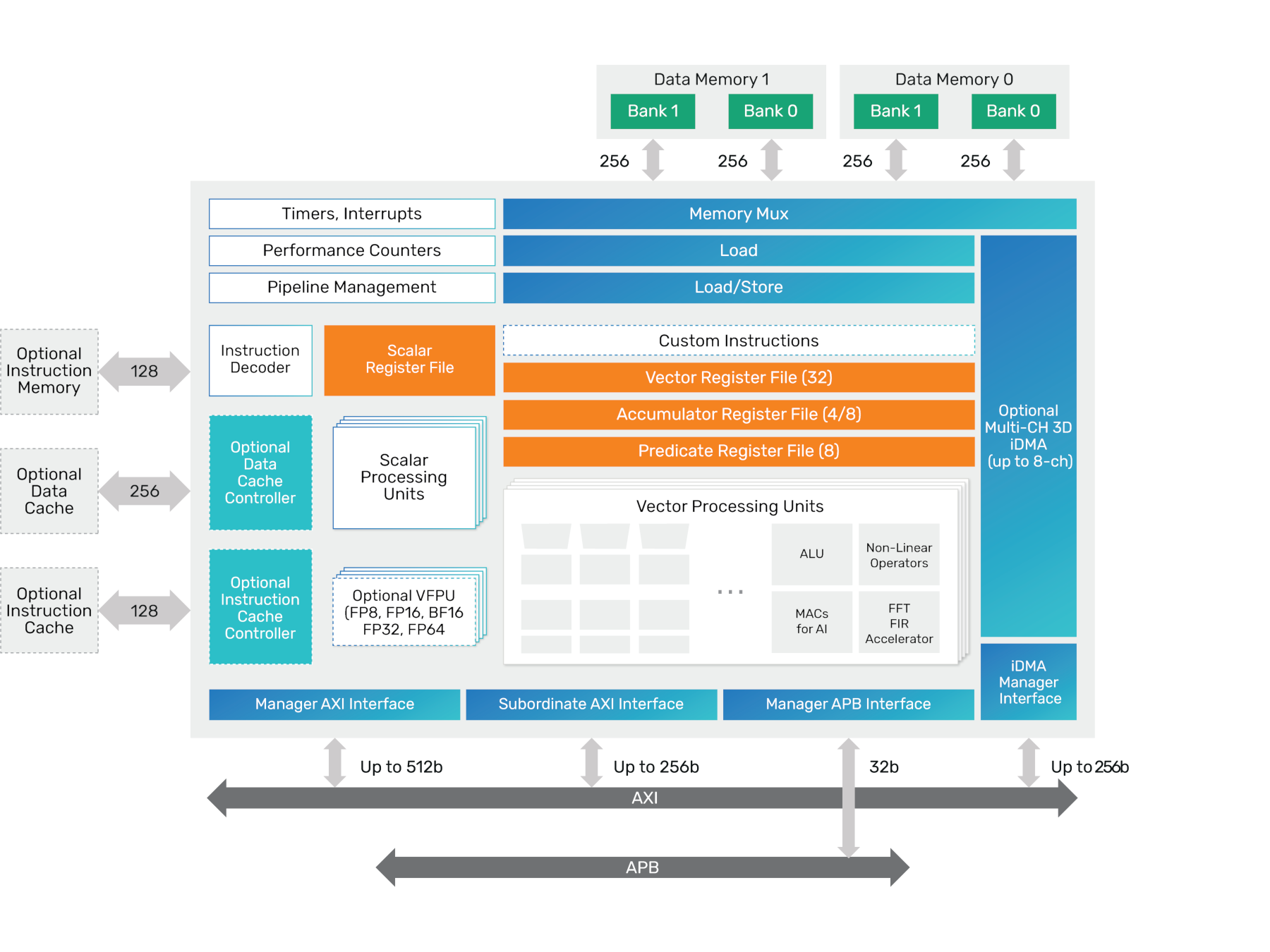
The Cadence Tensilica HiFi IQ boosts classic audio-processing performance and delivers several times the AI throughput. Architectural upgrades also improve energy efficiency, especially on AI kernels. Shipping to early-access customers this quarter, this sixth-gen HiFi DSP should enter general availability in the second quarter.
Cadence builds HiFi DSPs on its Tensilica Xtensa architecture, which defines a scalar CPU baseline that it and customers can extend. The licensable HiFi IQ transforms the Xtensa LX8 design (IP) into a VLIW vector processor supplemented by accelerators, custom instructions, and additional memory and bus (AXI) ports. Design options include caches, bus widths, and a vector floating-point unit (VFPU).
What’s New with the HiFi IQ?
Compared with Cadence’s previous top-end audio DSP, the HiFi 5s, the new IQ doubles the number of SIMD lanes to 256 and widens load paths accordingly. In so doing, the IQ doubles the number of 32 × 32-bit multiply-accumulate (MAC) units and quadruples the number of 16 × 16-bit MACs. An upgraded VFPU adds support for FP8 and BF16 formats, commonly used in AI models, mapping these into an FP16 data path with twice the width of that in the 5s. Number crunchers will appreciate that FP64 throughput can increase by eightfold owing to the new VFPU also supporting this format.
Incremental upgrades include wider integer accumulators, more AI and complex-number instructions, and a better auto-vectorizing compiler. AI instructions include nonlinear operations, which can bottleneck AI workloads even when MAC throughput (TOPS) suggests AI performance is sufficient.
The wider, higher-throughput IQ will demand more power than its predecessors but will reduce the number of cycles required for sophisticated algorithms. Cadence projects energy to fall by half or more on AI kernels and be incrementally lower on algorithms such as FFTs and FIR filters. Customers needing less performance can save power and area by employing other HiFi editions, such as the low-cost HiFi 1s.
Target Applications
Licensees integrate HiFi DSPs into embedded processors, PC core logic, and SoCs for smartphones and TVs. Automotive applications are a major target and present rising processing challenges as the number of speakers in the car cabin increases, noise cancellation becomes more sophisticated, and voice-command interfaces evolve from systems with small (and often misunderstood) vocabularies to a voice assistant based on locally hosted language models. As with video processing, AI is supplementing classical algorithms.
Infotainment systems aren’t critical, so the initial HiFi IQ release isn’t safety certified. It is, however, certifiable owing to Cadence’s design methodologies and the LX8 already complying with functional safety standards, and the company could release a certified version.
Enablement
Critical to HiFi’s acceptance has been its audio software, supplied by Cadence and dozens of independent software vendors, including many targeting the automotive market. Code will need to be recompiled for the IQ’s new architecture, which we do not expect to pose a barrier.
For AI models, Cadence has an ahead-of-time workflow, a TensorFlow Lite Micro runtime, and support for ExecuTorch and LiteRT frameworks. The company leverages this enablement among its Xtensa-based HiFi DSPs, Vision DSPs, and NPUs.
Competition
Long-time Tensilica alternatives include Arc (which Synopsys recently sold to GlobalFoundries) and Ceva DSPs. Both offer versions for audio. Ceva’s solutions are narrowly targeted, such as for noise cancellation and 3D audio rendering, and the Arc offering was more relevant in the DVD era.
Bottom Line
For many audio applications, the HiFi IQ will be overkill, and another HiFi model will be a better fit. However, the IQ is for designs powering many speakers and employing several microphones. It enables layering classical signal-processing algorithms and neural networks. The closest alternative is to employ multiple HiFi 5s cores, which will require more area, power, and software complexity. The Tensilica HiFi IQ is a significant upgrade for next-generation car and consumer audio.