

Ceva has begun licensing its third-generation PentaG intellectual property. Available in two configurations, the updated PentaG enables customers without cellular expertise to add 5G connectivity to their designs. The PentaG-NTN works with non-terrestrial networks, and the PentaG-Edge targets customers adding cellular data connectivity to their designs.
It’s easy to think that 5G cellular technologies are mature and fully deployed, but a few areas are new and drawing in companies looking for modems that differ from those in smartphones. Cellular-connected embedded devices (IoT devices) and satellite–connected (NTN) systems have requirements distinct from phones. Moreover, chips for such systems usually come from companies inexperienced in developing modems, creating an opportunity for DSP specialist Ceva to supply designs (IP).
As with previous PentaG generations, PentaG-NTN and -Edge bundle the DSPs and hardware accelerators required to assemble a modem. However, whereas the earlier IP was a kit for modem experts to assemble and program, the third-gen PentaG editions are complete. Ceva has integrated DSPs (including the XC21), accelerators, interconnect, and memory, as Figure 1 shows. Instead of supplying reference code, the company has integrated optimized, production-quality Layer 1 (L1) software, including NTN algorithms. The new PentaG replaces the earlier versions’ software-based flow control with hardware to improve power and performance. The hardware executes a descriptor list, enabling Ceva or its customers to detour execution to DSP code.
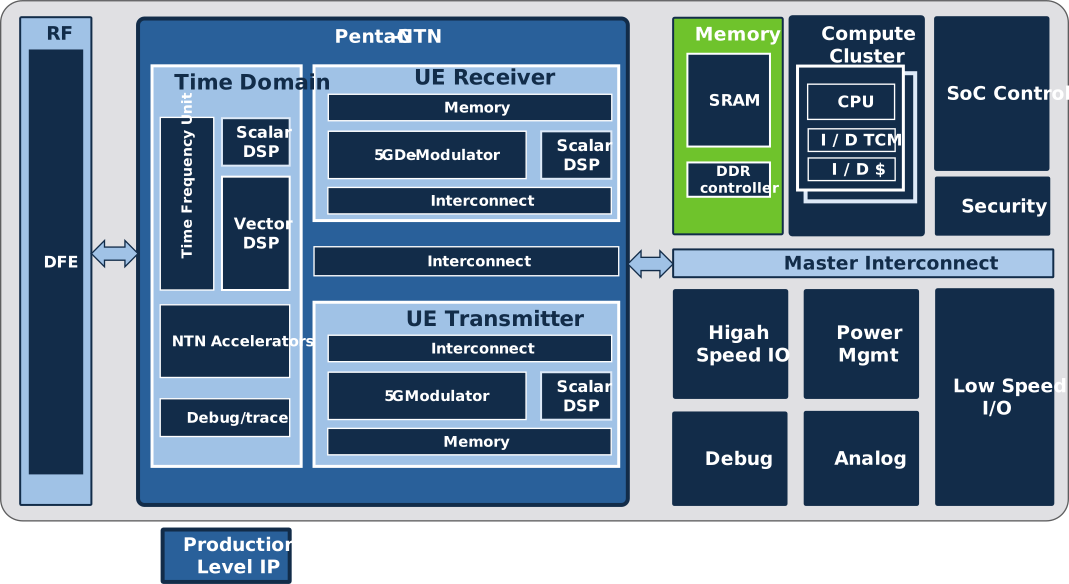
PentaG-NTN for Satellite Terminals
Satellite communication is transforming from a niche addressed by proprietary technology to a standards-based consumer product. The 3GPP added preliminary NTN support to the 5G specification in Release 17, completed in 2022. The 2024 Release 18 (5G-Advanced) rounded out the spec and covered a higher frequency range (FR2).
Employing infrastructure separate from established telecommunications networks, non-terrestrial networking draws in new service providers and chip suppliers. They may have expertise in satellite design and launch, but they lack it in standards-based user equipment (UE). Despite 5G-NTN’s standardization, satellite providers prefer vertical integration and design and supply the UE instead of letting other companies supply it.
High-data-rate satellite communications also pose challenges, even for experienced terrestrial-radio developers. Satellites are 100–10,000× farther from users than regular base stations, raising communication delays. The distance also introduces more opportunities for the atmosphere to corrupt signals. For these reasons, existing error-correction protocols had to be abandoned or retooled for NTN. Satellites, moreover, move 1,000× faster relative to the user than a car passenger moves relative to a base station, resulting in Doppler shifts that can wipe out the OFDM signals 5G employs.
PentaG-Edge for the IoT
Fortunately, although terrestrial 5G in the FR2 (sometimes called millimeter wave or Ultra 5G) fizzled out, it gave Ceva experience dealing with the band and its complexities. Building on this background, Ceva began working on its third-gen PentaG two years ago. Just as it recognized NTN was drawing in companies requiring turnkey modems, Ceva saw that many IoT-chip developers lacked wireless expertise, and they also needed a turnkey modem.
Edge systems had previously used 4G and earlier technology for data connectivity. The 3GPP’s Release 17 added reduced capability (RedCap) protocols to the 5G standard to enable IoT devices to work with 5G networks, and Release 18 enhanced these protocols. RedCap supports greater data rates than the skinniest wireless protocols but less than the broadband rates required by smartphone and fixed-wireless services. It also has features to extend battery life and reduce communication latency.
Decreasing the maximum data rate and eliminating some features reduces RedCap modem costs. Nonetheless, a RedCap modem may still support MIMO and must contend with multipath interference, neither of which is present in the NTN case. Because of these differences, PentaG-Edge is distinct from PentaG-NTN. Ceva expects companies developing SoCs for applications such as robotics, drones, automotive (V2X), smartwatches, and smart glasses to license the IP.
Competition
Ceva is among the few companies licensing modem IP. The PentaG-Edge faces competition from Sequans, which licenses RedCap modem technology that builds on its experience supplying standalone 4G IoT modem chips. Sequans is a much smaller company, however. It generated fourth-quarter revenue of $7 million compared with $31 million for Ceva, indicating Ceva will be better able to support customers during the five-plus-year lifecycle of their chips. Moreover, Ceva is profitable on a non-GAAP basis. By contrast, Sequans posted a $74.5 million operating loss, exacerbated by an unrealized loss from its bitcoin-treasury side quest.
Cadence has been a longtime Ceva competitor, offering DSPs based on its Tensilica technology. However, it has not focused on 5G designs and doesn’t offer any IP comparable to PentaG.
Bottom Line
Ceva is an established IP company, licensing AI accelerators (NPUs), DSPs, and IP subsystems, such as the new PentaG. Having licensed two generations of PentaG IP kits, it has taken the step toward offering finished modems. The PentaG-Edge is a strong choice for those developing IoT ASSPs or microcontrollers/microprocessors for consumer and industrial applications. The PentaG-NTN will help vertically integrated satellite companies complete custom chips. Ceva is well positioned to capitalize on the trend of 5G expanding beyond traditional telecom applications.