
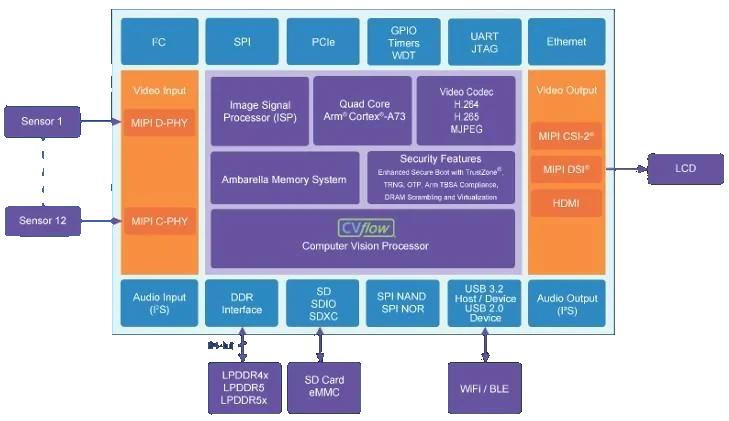
Computer-vision specialist Ambarella has begun sampling its new flagship CV-family processor, the CV7. It combines the 8K resolution of the previous CV5 flagship and the midtier CV72’s newer AI architecture. The company’s first 4 nm chip, the CV7, requires 20% less power than the CV5 and delivers 2.5× the AI throughput on the company’s metrics (about 33% more than the CV72), twice the video-encoding throughput, and four Arm Cortex-A73 cores instead of two more powerful Cortex-A76 CPUs. Ambarella is also revamping its go-to-market approach to reduce developers’ reliance on direct support.
Ambarella will report sales of about $390 million for the 12 months ending January 31, 2026, up 36% from the previous year. Known in computer-vision (CV) and edge-AI circles, the company is less familiar than the brands whose products it powers. Its products have powered GoPro action cams, DJI drones, Garmin dashcams, Insta360 cameras, Axis security cameras, Bosch ADAS systems, and other devices.
The CV7 can upgrade such systems, and it can enable “edge boxes” that analyze a dozen or more video streams and process other sensor data, employing CV techniques, convolutional neural networks (CNNs), and transformer-based networks, such as large language models (LLMs). The same technologies also help camera makers improve image quality, framing, image stitching for 360° views, and driver monitoring.
What Differentiates Ambarella?
Ambarella’s key differentiator is its CV engine, CVflow, which complements the image signal processor (ISP), quad-core CPU complex, and video encoders and decoders (codecs). Now in its third generation, CVflow handles CV, CNN, radar processing, and transformer functions (including nonlinear operations). Whereas an ISP can handle color-space conversion, tone mapping, and exposure compensation, CVflow can employ AI techniques to better reduce noise and improve color, as well as for object detection and image segmentation. Ambarella offers developer tools to enable customers to execute their models on CVflow.
The codecs’ performance defines the CV7’s video throughput. The chip can encode a single 4KP240 stream or two 8KP30 streams—rates and resolutions required by next-gen action/360° cameras. It can also handle multiple videos of lower resolution and frame rate for edge boxes, automotive, and robotics applications.
Ambarella has directly supported customers, implementing specific CV algorithms and aiding software development. This approach is fine when a company has only a few, high-volume customers but doesn’t scale to a broader base. Ambarella, therefore, now also indirectly supports customers and independent software vendors (ISVs). It has launched the developer.ambarella.com portal to this end. The portal provides access to a model zoo, documentation, and templates to help developers begin work. It also links to GitHub and Hugging Face repositories.
Competition
Such enablement is typical of companies supplying AI accelerators (NPUs) or embedded processors targeting the broader market. Ambarella competes with NPU companies such as Axelera. Also targeting 8K systems, the Axelera Europa has greater peak processing performance and DRAM throughput than the CV7, making Europa a better choice for workloads requiring more AI throughput and aligning it more with the Ambarella N1 or N1-655. Europa’s lesser integration renders it less suitable for cost-sensitive designs. It has multiple CPUs, but they’re for video and AI processing; they don’t obviate a host. Moreover, it includes only a 4KP120-capable video decoder (half the CV7’s max frame rate) and no video encoder.
The i.MX 95 handles 4K video and integrates more peripherals than the CV7, such as 10 Gbps Ethernet, a GPU, microcontroller subsystems, and CAN interfaces. Its six Cortex-A55 CPUs in aggregate provide less general-purpose processing than the CV7’s Cortex-A73 quartet. Its 2 TOPS NPU delivers a fraction of the peak throughput of the CV7. NXP’s enablement is excellent, but the i.MX 95 is too wimpy to address the same applications that the CV7 targets. An even lower-performing alternative is the Renesas RZ/G3E.
Bottom Line
The CV7 advances Ambarella’s strength: video processors for consumer, security, automotive, and IoT applications. It doesn’t break new ground but raises throughput to support 240 FPS 4K and multiple 8K streams, enabling action-cam upgrades. Translated to multiple lower-resolution/frame-rate streams, the added throughput should expand Ambarella’s serviceable market by enabling edge boxes. Enablement is critical to processor companies, and Ambarella’s new go-to-market approach will help it increase its customer base.